Holding the Zones Note 2 of 7
Both Zones Warm: When a Sub-Zero Wine Unit Stops Pulling Down
- Written by
- Bjorn Aaltonen
- Bench
- wine storage and dual zones
- Years in the trade
- 15
- Refrigerant
- EPA 608 certified
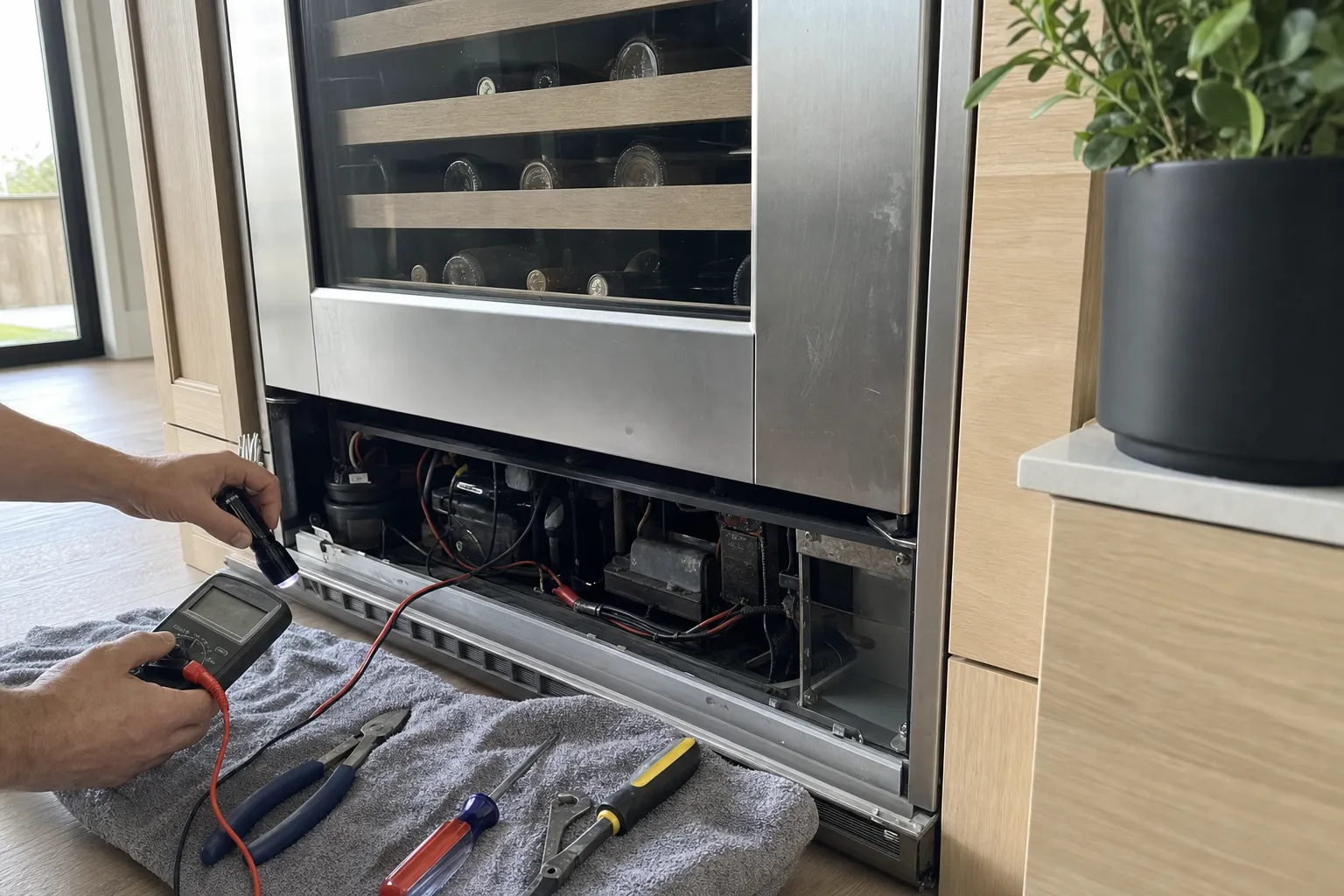
When both zones of a wine cooler drift up together, the question changes. On Mercer Island the answer is usually in the machine bay at floor level, where lake-damp dust and tight remodel joinery stop the unit getting rid of its own heat.
This note covers the case where both zones are warm. If one zone has walked away while the other holds, that is a different fault, and the first note in this series deals with it.
What two warm zones tell us
Sub-Zero describes its wine storage as having dual evaporators, one for each zone. Each zone has its own coil and its own sensor, so a fault that belongs to one zone shows up in that zone alone. When both climb together, we stop looking at either zone and start looking at what they share: the power, the control, the door, and the refrigeration machinery that makes the cold for both.
Of those, the one that fails most often is not a part at all. It is heat that cannot leave. A refrigeration system moves heat out of the cabinet and dumps it through the condenser; if the condenser cannot shed it, the whole system runs hotter and longer and still falls short. On an undercounter unit that happens slowly, over months, and the owner notices the bottles before the display.
The machine bay comes first
On Sub-Zero undercounter units the condenser sits behind the kickplate, a few inches off the floor. That is exactly where the vacuum pushes dust, where pet hair collects and where lake-damp air lets fine dirt cling to the fins. Sub-Zero’s guide for the older UC-24 models says the SERVICE indicator will flash when the condenser needs cleaning; on the current Designer controls, the settings menu carries troubleshooting and service information instead.
A blanketed coil produces a recognizable pattern. The unit runs almost without stopping, the air at the grille feels warm and weak, and both zones settle a few degrees above their set points instead of reaching them. The condenser fan that pulls air across the coil works harder against the dirt and eventually starts to fail on its own, which is why a cleaning left too long can become a part.
Cleaning is manufacturer-sanctioned owner maintenance, done with the power off. Sub-Zero’s guides call for a soft brush and a vacuum, gloves against the sharp fins, and strokes along the fins rather than across them. If the coil is matted solid or the fan behind it sounds rough, leave the rest to us.
The air around the cabinet
A clean condenser still needs air to reach it. Sub-Zero’s current undercounter guide warns owners to keep the ventilation openings in the appliance and in the cabinetry around it clear, and island remodels do not always manage that. A toe-kick board fitted tight across the grille, a rug pushed against it, or a surround with no gap at the top will all trap warm air where the unit breathes. The Under the Counter note on toe-kick ventilation goes through the common layouts.
Room temperature matters too. Sub-Zero notes that warmer surroundings make the compressor run longer, and a unit that coped through a cool spring can fall behind in the first warm spell of summer. That is not a fault in itself, but it exposes one, usually a condenser that was already half blocked.
The door and the lights
A door held a fraction of an inch off its gasket lets room air in all day. Both zones warm, the glass may fog, and the unit runs constantly. The usual culprit is a bottle neck or a rack edge sitting too far forward rather than a failed seal, so check that before anything else. Sub-Zero also turns the interior lights off when a door is left ajar, to keep their heat out of the cabinet; lights that stay dark after an hour with the door properly shut are worth mentioning when you call.
When the display disagrees with the bottles
The display shows what each zone’s sensor reads, and a sensor can drift. A probe in a glass of water on a middle rack, left overnight, tells you what the wine is actually living at. If both probes agree with the display and both are high, the unit really is warm. If the display reads perfectly while the probes read high, the fault may sit in how the unit measures rather than how it cools. On current Designer undercounter models, Sub-Zero also describes a showroom mode that shows set temperatures without cooling.
What we do on the visit
We probe both zones against the display, take the kickplate off, and look at the coil and the fan behind it. Then we check how the unit is built in, how the door closes, and whether the control is calling for cooling. Only when all of that is clear do gauges go on the sealed system, under EPA Section 608 certification, because a compressor is the last thing we condemn and the rarest thing we find. If it does come to that, it is booked as wine storage repair with the price agreed before any part is ordered.
Before you call
-
Step 1
Check the breaker and the display
A tripped breaker or a unit switched off at its own panel reads as a warm cabinet. Confirm the display is lit and showing both set points before anything else.
-
Step 2
Look at the kickplate grille
Without removing anything, look for a rug, a toe-kick board or boxes pressed against the grille at floor level. The unit pushes its heat out there.
-
Step 3
Close the door and watch it seal
Shut the door gently and check it pulls closed on its own, with no bottle neck or rack edge holding it off the gasket.
-
Step 4
Probe both zones overnight
Stand a thermometer probe in a glass of water on a middle rack in each zone and read both in the morning, next to what the display says.
Past these checks the fault is inside the machine. Call Mercer Island Sub-Zero Service on (206) 208-3377 and say which step changed nothing.
Asked about this
Both zones are four degrees warm. Is the compressor failing?
Probably not. When both zones warm together the shared machine is involved, and on an undercounter unit the first suspect is a condenser behind the kickplate that can no longer shed heat. Airflow around the cabinet and a door that does not quite close come next. The compressor is only judged with gauges, after those are ruled out.
The display shows the right temperatures but the bottles feel warm. Which do I believe?
Believe a probe in a glass of water left overnight. The display reports what the zone sensor reads, and a sensor can drift. On current Designer undercounter models, Sub-Zero's guide also warns that a unit left in showroom mode shows its set temperatures without cooling at all. Mercer Island Sub-Zero Service can check both on (206) 208-3377.
How often should the condenser behind the kickplate be cleaned?
Sub-Zero's own undercounter guides give two intervals: every three to six months for the older UC-24 models, and every six to twelve months for the current Designer undercounter line. Switch the unit off first, then brush the coil gently and vacuum in the direction the fins run, never across them. In a dusty remodel or a house with pets, go by the shorter end.