Under the Counter Note 1 of 6
A Sub-Zero Undercounter Refrigerator That Has Stopped Cooling
- Written by
- Bjorn Aaltonen
- Bench
- wine storage and dual zones
- Years in the trade
- 15
- Refrigerant
- EPA 608 certified
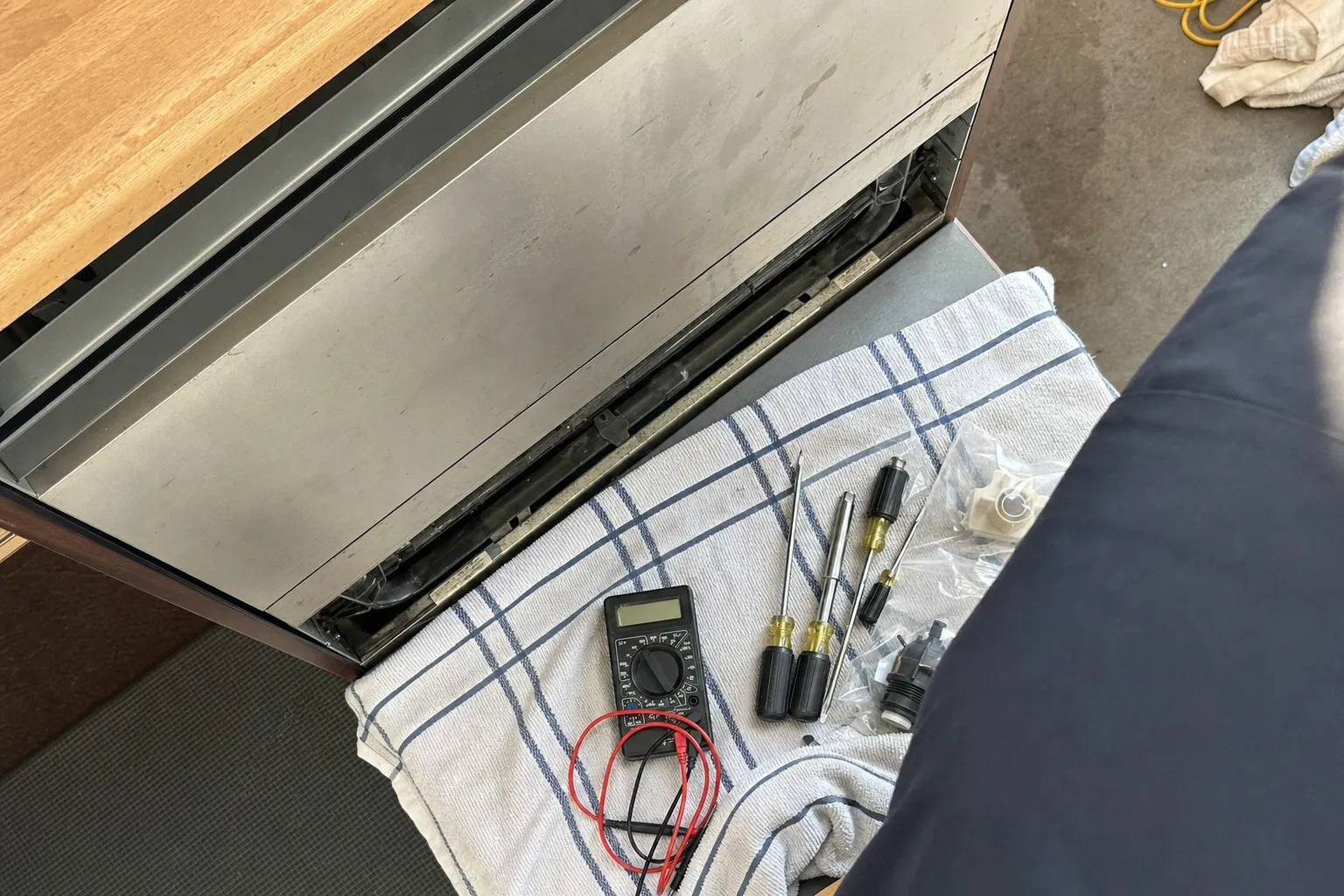
An undercounter refrigerator that has gone warm has usually lost a fight with its surroundings before it has lost a part. On Mercer Island those surroundings tend to be a remodel that set the unit snugly into bar or kitchen cabinetry, and a film of damp dust across the coil behind its kickplate.
This note works from the outside in: power and settings first, then air, then the door, and only then the machinery. It covers undercounter refrigerators and the refrigerator side of combination units. Wine units behave differently enough to have their own series, Holding the Zones.
Power and the control panel
A cabinet with no light and no cooling has normally lost power rather than a part, and Sub-Zero’s own troubleshooting starts in the same place: is the unit switched on, and is the breaker on. On the older UC-24 models the POWER key turns the unit off at its own panel and the display then reads OFF, which is easy to do by accident while wiping the controls. The current Designer models start up with a touch and hold on POWER.
Bars deserve one extra look. Outlets beside a sink usually carry test and reset buttons, and a bar is exactly where they tend to be fitted. If the unit is dead and a ground fault outlet on its circuit has tripped, reset it once. If it trips again, that is a question for an electrician about the circuit, not a refrigeration fault.
One setting imitates a failure almost perfectly. Sub-Zero describes a showroom mode in which the display shows set temperatures while the unit does no cooling at all, and its guides tell owners to contact Sub-Zero’s customer care about it. If the display looks perfect and the milk is warm, say so when you call.
The coil behind the kickplate
If there is power, look down. Sub-Zero places the condenser of its undercounter units behind the kickplate, at floor level. That coil is where the heat pulled out of the cabinet is released into the room, and a fan draws room air in through it. When lint and dust mat the fins, the heat stays in the machine, the compressor runs longer on every cycle, and the cabinet creeps up a degree at a time over weeks.
The older UC-24 models have a warning for this. SERVICE flashes on the display when the control detects a temperature problem or a condenser in need of cleaning, and what Sub-Zero advises depends on the cabinet. Still near normal: switch off, clean the condenser, confirm nothing stops the door closing, switch on again. Already warm, or SERVICE back after the cleaning: that is a service call.
Cleaning is the one job behind the kickplate that Sub-Zero hands to the owner. The interval depends on the generation: every three to six months for the UC-24 models, every six to twelve for the current Designer line, whose kickplate comes off with two mounting screws. A household with shedding pets wants it done more often than that. Turn the unit off at the control panel, wear gloves because the fins are sharp, and use a soft brush and a vacuum moving the same way the fins run so none of them fold over. Chemical coil cleaners are unnecessary; a brush and a vacuum are the whole kit. The condenser fan behind the coil is not an owner part; if it is caked, stiff or noisy, leave it for the visit.
Air around the cabinet
A clean coil still needs a path for air. Sub-Zero’s warning on the Designer line covers both the unit’s own vents and the cabinetry built around them: neither may be obstructed. Island remodels do not always honor that. A matching toe-kick board carried across the grille, a runner that has crept under the kickplate, or cartons stored against it will each leave the unit breathing its own warm exhaust. The toe-kick note in this series goes through those layouts one by one.
The room counts as well. A warm room lengthens every compressor cycle, which Sub-Zero’s troubleshooting lists acknowledge. A bar that bakes in west-facing afternoon light, or a pantry beside an unheated space, can push a unit past what it can hold without anything inside being broken.
The door and the load
A door that does not quite close admits room air all day, and on the island that air brings damp as well as heat. Check that it pulls flush against the gasket, that nothing in the door bins or on a shelf edge holds it open, and that the gasket has no rips or tears; Sub-Zero treats a torn gasket as a service item. Dark interior lights are a clue too. When a door is left ajar, Sub-Zero switches the lights off to keep their heat out of the cabinet and asks owners to keep the door closed for an hour before treating them as a fault.
Use matters. How much is inside, how warm it was when it went in, and how often and how long the door stands open all decide how much the compressor has to run. A cabinet restocked with warm drinks before guests arrive will take hours to come back down, and that is normal. One that is still warm the next morning is not.
What we check, and in what order
On the visit we compare a probe reading with the display and lift the kickplate away to inspect the coil and its fan. Then we check how the unit sits in its opening and how the door seals, whether the control is calling for cooling, and whether the compressor starts when it does. The sealed system comes last. Sub-Zero notes that its current Designer undercounter line uses a flammable refrigerant, one more reason that part of the job never belongs to an owner. Whatever the cause, the work is booked as refrigerator repair and priced once the diagnosis is done, before anything is ordered.
Before you call
-
Step 1
Confirm the unit has power
Look at the display. On the older UC-24 models OFF means it was switched off at its own panel. A dark display points to the breaker, or to a tripped outlet with test and reset buttons.
-
Step 2
Read what the panel is telling you
Note whether SERVICE is flashing, and whether the display shows its set temperature while the cabinet stays warm. Sub-Zero links the second pattern to showroom mode.
-
Step 3
Put a thermometer in water overnight
Sit the probe in a cup of water halfway up the cabinet and compare it with the display next morning. Write both numbers down for the call.
-
Step 4
Clear the floor at the kickplate
Move any rug, carton, bag or pet bed that sits against the grille, then give the unit a full day to recover.
-
Step 5
Shut the door and watch it seat
It should settle flush against its gasket. Look for a bottle in the door bins or a shelf edge holding it proud.
Past these checks the fault is inside the machine. Call Mercer Island Sub-Zero Service on (206) 208-3377 and say which step changed nothing.
Asked about this
The display is flashing SERVICE. Does that mean it is broken?
Not necessarily. On the older UC-24 undercounter models Sub-Zero uses SERVICE to flag either a temperature problem or a condenser that needs cleaning. If the cabinet is still close to normal, switch it off, clean the condenser, make sure the door can close, and switch it back on. If it is already warm, or SERVICE returns, book a technician.
I cleaned the condenser. How long before it should be cold again?
Give it a day. A cabinet that has not come back to its set point twenty-four hours after a condenser cleaning is one we want to see. Keep the door shut as much as you can meanwhile, and judge by a thermometer in water rather than the display. If it is still warm tomorrow, ring Mercer Island Sub-Zero Service on (206) 208-3377.
Can I turn the temperature down to make up for it?
It rarely helps. A unit that cannot get rid of its heat will not cool better because it is asked for a lower number; it simply runs longer. On the current Designer undercounter line a refrigerator leaves the factory set at 38°F and adjusts one degree at a time, so note your setting before you change it and put it back afterwards.