Under the Counter Note 3 of 6
Refrigerator Drawers That No Longer Pull Themselves Shut
- Written by
- Bjorn Aaltonen
- Bench
- wine storage and dual zones
- Years in the trade
- 15
- Refrigerant
- EPA 608 certified
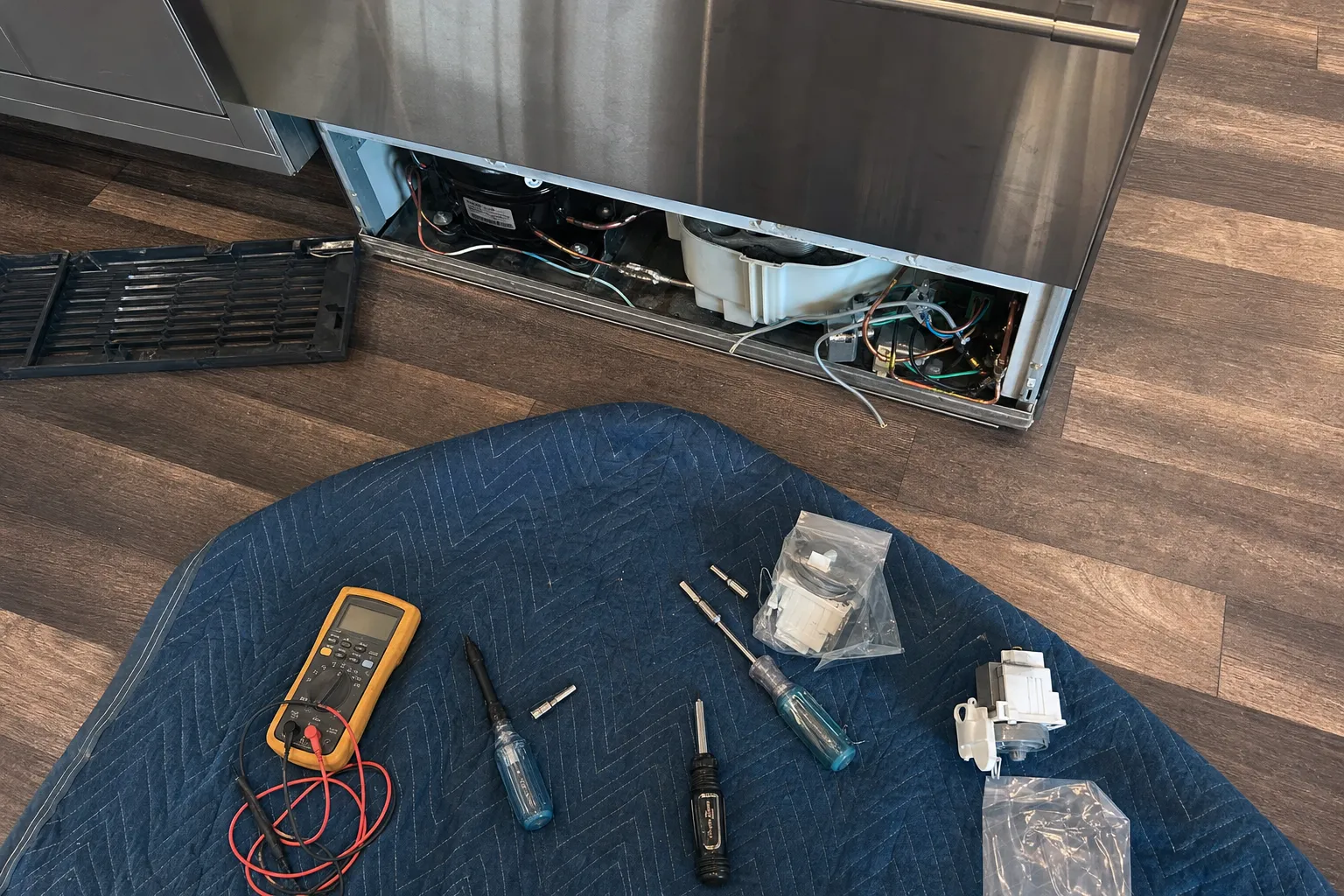
A refrigerator drawer that used to close with a light push and now stops a finger’s width short is telling you something has changed in the load, the slides or the seal. On Mercer Island that gap shows itself quickly, because the damp air off the lake that gets past an open seal settles as water on the drawer front and as frost at the back of the compartment.
This note is about Sub-Zero’s refrigerator drawers, including the drawer fitted to the current Designer undercounter line, and it applies in part to the drawers inside an undercounter refrigerator.
Why a small gap matters
A drawer seals the way a door does, with a gasket around its front pressing against the face of the cabinet. Leave a gap and room air flows in all day. Sub-Zero lists a door that is not closing properly, or one left ajar, among the first things to check when it troubleshoots frost, condensation and high temperatures, and a drawer front is a door by another name. The Designer controls carry a door alarm for exactly this reason, and their Settings menu switches it on and sets how long the door may stand open before it sounds. An alarm that sounds with the drawer apparently shut is the same fault, heard rather than seen.
What usually stops a drawer
The load. Drawers in a bar or pantry are packed from above, and a bottle lying across the top or a tall carton at the back is enough to catch the cabinet as the drawer runs in. Take out whatever sits highest and try again.
Something behind it. Small items ride over the back of the drawer and wedge between it and the cabinet. Sub-Zero documents how the refrigerator drawer comes out: pull it forward until it stops, lift the front slightly and pull it straight out. To refit it, engage it into the side rails and slide it back into position. Any drawer above it is ours to take out, not yours.
The slides. A drawer that runs rough, drops at one corner or needs lifting at the end of its travel may have a slide that has bent or worn under heavy loads. That is a diagnosis for the visit; do not try to bend anything straight.
The gasket. Sub-Zero’s troubleshooting treats a gasket with rips or tears as a service item. If moisture is weeping from the seal, clean it and dry it thoroughly before judging it. Why a tired seal can look fine until it is tested is explained on the glass-door gasket page; the rubber on a drawer ages the same way.
Water and frost as evidence
If you are not sure whether a drawer has been sealing, look inside it. Frost on the back of the compartment, water under the drawers or fog on the contents all say room air has been getting in. Keep the drawer shut, run a hand round the gasket, and look for water or ice at the back of the compartment and under the drawer front. Dry whatever you find. If it comes back while the drawer is closing properly, the leak is somewhere we need to find. The Lake Air notes follow that moisture further, onto glass and coils.
What we check
We watch how the drawer runs and where it stops, test the gasket all the way round, check the slides for wear and the cabinet for level, and then confirm the unit can hold its temperature once the seal is sound. A unit that has spent weeks fighting a leaking seal has worked its condenser hard, so we look at that coil too. Repairs go under refrigerator repair and are priced once we know the cause.
Before you call
-
Step 1
Take out whatever sits highest
Lift tall bottles and cartons out of the back of the drawer, then close it with one even push.
-
Step 2
Look behind the lower drawer
Pull it forward until it stops, lift the front slightly and draw it straight out, as the Designer undercounter guide describes. Leave any drawer above it to us.
-
Step 3
Run a hand around the gasket
Feel for rips, flattened lengths or a sticky patch. If moisture is weeping from the seal, clean it and dry it thoroughly.
-
Step 4
Close it and wait for the alarm
On Designer controls the door alarm sounds after the time set for it. If it sounds with the drawer apparently shut, the drawer is not reaching its seal.
Past these checks the fault is inside the machine. Call Mercer Island Sub-Zero Service on (206) 208-3377 and say which step changed nothing.
Asked about this
Can I replace a drawer gasket myself?
A torn or flattened seal is a service item; Sub-Zero's own troubleshooting sends a gasket with rips or tears to a technician. The drawer has to come out first, and the new seal must sit evenly in its channel or it leaks from the first day. Mercer Island Sub-Zero Service fits genuine Sub-Zero gaskets; call (206) 208-3377 with the model number from the rating plate.
Does it matter if the drawer is only open a crack?
Yes. A gap you can barely see lets room air in around the clock, and in a kitchen near the lake that air carries plenty of damp. It turns up as frost at the back, water under the drawer and a unit that runs longer than it should. The door alarm on Designer controls exists precisely because small gaps are easy to miss.