One Bridge Note 1 of 7
No Second Route: Diagnosing a Sub-Zero Right the First Time When I-90 Is the Only Way On and Off
- Written by
- Bjorn Aaltonen
- Bench
- wine storage and dual zones
- Years in the trade
- 15
- Refrigerant
- EPA 608 certified
The city describes Mercer Island as being in a unique position: the only city in the region whose citizens’ sole means of ingress and egress is access to an interstate highway. Everything comes and goes on I-90 — the floating bridges to the west, the East Channel Bridge to the east — and there is no surface alternative at any hour of any day.
For a repair van that is not a poetic detail, it is arithmetic. Parts come from the mainland, so every part fetched mid-job means crossing the water twice more, which is why what you tell us on the phone matters as much as what we find on arrival. A second trip that costs twenty minutes on the mainland can cost most of an afternoon here. So the discipline that island work forces on you is simple: find the whole fault the first time, and arrive carrying the parts the fault is likely to need.
Nowhere does that matter more than on ice.
The part of the year that matters
Late spring through September. Those are the months when the house is full — school out, boats in the water off Mercerwood, people entertaining on the deck — and that is precisely when a machine that has been quietly underperforming all winter gets asked for far more ice than it has been making.
The failure was usually already there. An ice maker that made slightly small cubes in February had the same fault in February; nobody minded, because nobody emptied the bin. In July the same fault reads as a machine that has broken.
What the swing asks of the machine
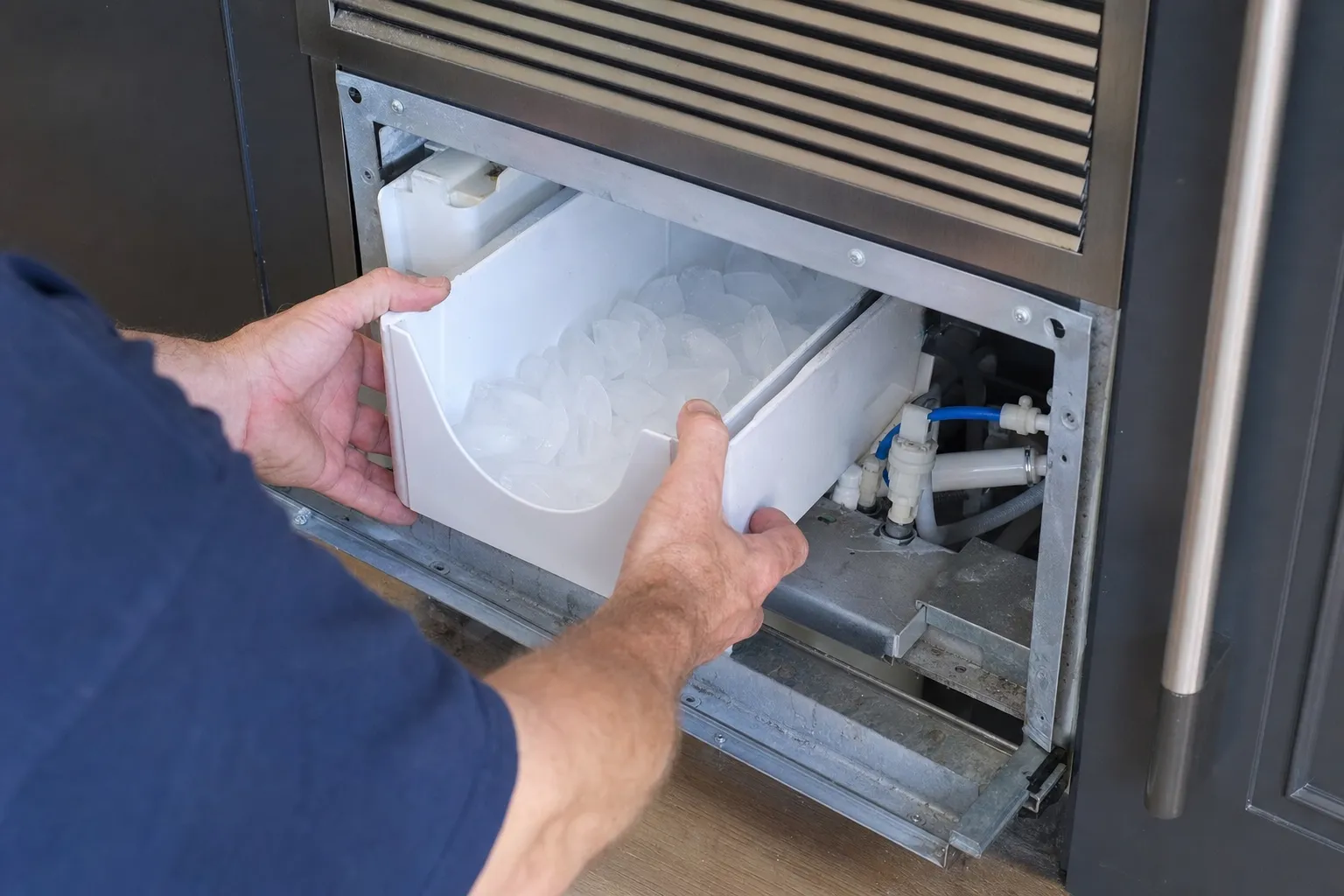
Sub-Zero has fitted more than one kind of ice maker over the years: modules inside the freezer of a built-in, and separate undercounter units whose whole job is ice. They fill, freeze and release in different ways, and they fail differently, so the first thing worth establishing on any call is which one you actually own, because much of the advice on the internet is written about another design.
What they share is a dependence on the water arriving in the right quantity at the right moment, and on a freezer cold enough to finish each batch. Sub-Zero’s own checklist for no ice starts there: the freezer near 0°F, the bin seated, the arm down and water reaching the unit.
Summer stacks two extra demands on both. Door traffic pulls humid air in, the same lake air the Lake Air notes follow onto glass doors and seals, and the harvest cycle has to work against a compartment that is warmer than it was at Christmas.
The failure it produces, and when
Four presentations come up again and again. Hollow or undersized cubes, which Sub-Zero’s undercounter troubleshooting answers first with a condenser clean, and which can also come from water arriving short. A bin filling with one welded slab instead of separate cubes, which is ice left too long or a harvest, airflow or door-seal problem. Production stopping entirely a day or two after a filter change. And water tracking down the inside of the cabinet from the fill tube area.
That third one deserves its own sentence, because it is so often a call-out that did not need to happen. A new filter cartridge introduces air into the line and can unseat if the head is not turned fully home; the machine then fills short, reads the shortfall as a completed cycle, and progressively fails. It looks like the module has died two days after somebody did routine maintenance, and the two events are related.
Cloudy cubes in an East Seattle or First Hill house with an older supply run often trace to the line rather than the appliance — a partially closed shutoff left half-turned after plumbing work, or a saddle valve slowly clogging.
Getting ahead of it
Run the dispenser or empty and discard the first two or three harvests after any filter change, and check the cartridge is seated with a firm quarter turn. Air in the line is the cheapest fault there is to prevent.
Find the shutoff that feeds the unit and confirm it is fully open, not cracked open. Then look at the bin: cubes packed hard against the sensing arm or the optical eye will stop production just as effectively as a broken module, and a scoop left buried in the bin does it too.
Do not chip at a slab with anything metal. In a Town Center condominium the water line and the freezer’s refrigerant tubing can be inches from where you are hammering, and puncturing either turns a modest repair into the largest one on the price list.
What we do on the visit
Because coming back is expensive, the first visit is built to be complete. We identify the ice maker type, time and measure an actual fill, check static and running pressure at the inlet valve, pull and inspect the valve screen, verify the fill tube and its heater, watch a full harvest cycle end to end rather than trusting the control’s own report, read the bin sensing circuit, and check the door seal and compartment temperature before we accept any of the readings above.
That sequence is why we ask for the model and the date of the last filter change before an ice maker repair visit: the more we know before crossing, the better the chance that the part the fault needs is already with us. On this island, a part ordered after the diagnosis is what turns one appointment into two.
The visit is $89 and comes off the bill once you approve the work. The repair itself is priced when the fault is found, before any part goes in, and a sealed-system fault is talked through with you before anything is opened.
Call (206) 208-3377 to book. If you know when the last filter change was, say so — it changes what we bring across the bridge.
Asked about this
My ice maker stopped two days after a filter change. Are the two related?
Quite possibly. A fresh cartridge introduces air into the supply line, and a head that has not been turned fully home can leave the seal short. The machine then fills less than it should, records the short fill as a completed cycle, and tails off over a day or two. Purge two or three harvests after every change.
Why do you ask so many questions before coming out to the island?
Because parts come from the mainland, and every component fetched mid-job means two more crossings. Knowing the model, which type of ice maker you have and what was done to the plumbing recently tells us which companion parts are worth bringing. Where the part allows it, that saves you a second appointment, and it saves us the driving.
The bin has one welded slab instead of separate cubes. Is the module dead?
Usually not. Sub-Zero notes that ice left unused can fuse together; otherwise a slab points at harvest, airflow or door sealing rather than the module, because cubes that partly thaw and refreeze bond to each other. We check the seal and compartment temperature before condemning any part.