Lake Air Note 6 of 7
Frost Where There Should Be None: The Wine Evaporator
- Written by
- Bjorn Aaltonen
- Bench
- wine storage and dual zones
- Years in the trade
- 15
- Refrigerant
- EPA 608 certified
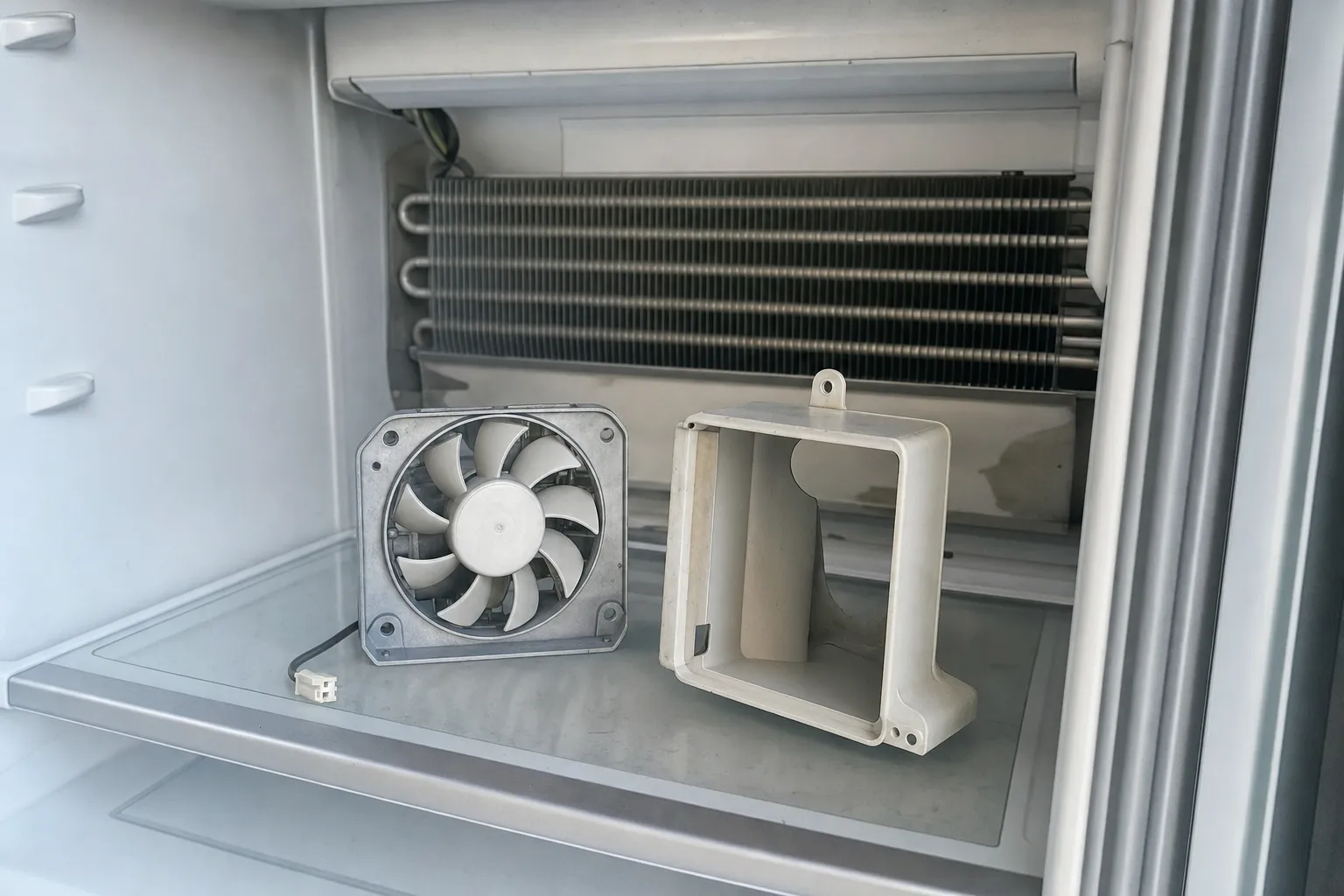
A wine cooler holds its zones at cellar temperatures, well above freezing, so white frost on a back wall means something has changed. On Mercer Island the change usually starts at the door: every opening lets lake-damp air into the cabinet, and the coil that cools the zone is where that moisture turns to ice.
This note covers where the frost shows, how to clear it without damage, and what it points to once it is gone.
Where the frost shows
Frost in a wine unit tends to appear in a few recognizable places. It forms on the back wall of a zone, often over or around the cover that hides the coil. It gathers around the openings in the rear panel where air moves through. It can coat the backs of the bottles standing nearest the wall. And in a bad case it becomes a solid sheet of ice rather than a dusting.
Frost is not the same as condensation. Water beads and runs; frost is white and crystalline and stays put. A little of either after a long evening of loading can be normal. Frost that builds from week to week, or returns soon after it has been cleared, is the kind worth chasing.
Why a wine zone should not frost
Sub-Zero builds its wine storage with dual evaporators, one for each zone. Each coil runs colder than the zone it serves, so it collects moisture from the air that passes across it. As a general rule of refrigeration, in a cabinet kept well above freezing, whatever freezes onto the coil while the unit runs clears again in the pauses between runs. Frost that builds and stays means one of three things has gone wrong.
More moisture is coming in than the coil can deal with. A door that no longer seats, a seal that has hardened or split, a door left ajar, or a long evening of opening and closing all feed the coil lake air.
The air has stopped moving across the coil. The fan that pushes air over a zone’s coil can slow, stop or ice up, and bottles or cases pushed hard against the rear wall can block the flow. Still air lets frost pile up in one place.
The coil never gets a break. A zone sensor that reads warmer than the zone really is keeps that zone calling for cold. A unit that cannot shed its heat through the condenser behind the kickplate runs almost without pause. Either way the coil stays cold long enough for frost to win.
What the two coils are, and how each one fails, is set out on the zone evaporators page.
Clearing it without damage
For heavy icing, Sub-Zero’s undercounter guides describe a slow, gentle method. The unit is switched off first. The ice is then warmed with a hair dryer on its low setting, moved about constantly so no one spot takes the heat, and the meltwater is wiped up with a cloth or paper towels as it comes away. The current Designer undercounter guide adds a warning against mechanical devices or any other way of speeding up the defrost that the manufacturer does not recommend.
That rules out knives, scrapers, ice picks, heat guns and pans of boiling water. The fins and tubing under the frost are thin, and a puncture there turns a moisture problem into sealed-system work.
Take the bottles out of the zone before you start, and lay towels along the bottom of the cabinet opening. Then note the date. Clearing the frost is the first step of the diagnosis, not the cure.
One zone or both
Because each zone has its own coil, frost in one zone points to that zone’s own parts: its fan, its sensor, the section of seal nearest it, or a row of bottles blocking its wall. If that zone has also crept warm while the other holds, the Holding the Zones note on zones drifting apart follows the temperature side of the same fault.
Frost in both zones points to what they share: the door, on units where one door covers both zones; the condenser; the room around the unit; and how often the door is being opened.
What we check on the visit
We start with the door and the seal, because they are the quickest to test and damp island air punishes either one. Next comes the frost itself, whether it covers the whole coil evenly or only part of it, since a patchy pattern can point beyond the door. Then the zone’s fan: whether it turns, whether its blades are clear, whether it sounds right. The zone’s sensor is checked against a probe, and the condenser behind the kickplate gets cleaned and inspected. Gauges go on the sealed system last, only when everything else is clear.
The repair is booked as wine storage repair, and whatever part it needs is priced once the diagnosis is finished.
Before you call
-
Step 1
Note which zone and where the frost sits
Upper or lower zone, the whole back wall or one patch, a dusting or a solid sheet. A photo helps, and it is worth taking before you clear anything.
-
Step 2
Pull bottles back from the rear wall
Bottles or cases pushed hard against the back of a zone can block the air moving across its coil. Leave a clear gap behind them.
-
Step 3
Watch the door close and seal
Give the door a gentle push from half open. It ought to finish the swing by itself and settle flat against the cabinet, with no bottle or rack front in the way.
-
Step 4
Melt heavy ice with the unit off
Bottles out, towels below, unit switched off. Use a hair dryer on its lowest setting and never let it rest in one spot. No knives, scrapers or heat guns; mop the water up as it melts.
-
Step 5
Note how soon the frost returns
Once it is clear and the unit is running again, check the back wall every day or two. How fast the frost comes back, and where, is the best clue we get.
Past these checks the fault is inside the machine. Call Mercer Island Sub-Zero Service on (206) 208-3377 and say which step changed nothing.
Asked about this
Is a little frost on the back wall of a wine zone normal?
A wine zone runs far warmer than a freezer, so frost you can see, and that stays, is not something these units should show. A light film that has gone by the next morning after a busy evening may simply be door traffic clearing. Frost that thickens, or returns soon after you melt it, has a cause worth finding.
Can I scrape or chip the ice off to save time?
Please do not. Sub-Zero's current undercounter guide warns against using mechanical devices or other means to speed up defrosting beyond what it recommends, and what it recommends is gentle: unit off, hair dryer on low, kept moving. The coil under the ice is thin metal, and a slip with a blade can puncture it and turn frost into a sealed-system repair.
The frost came back a week after I melted it. What now?
Then whatever caused it is still there: a door that does not seal, air that has stopped moving across the coil, or a zone that never stops calling for cold. Melting it again only resets the clock. Mercer Island Sub-Zero Service, (206) 208-3377, can read the returning frost pattern, which is often the most useful clue there is.